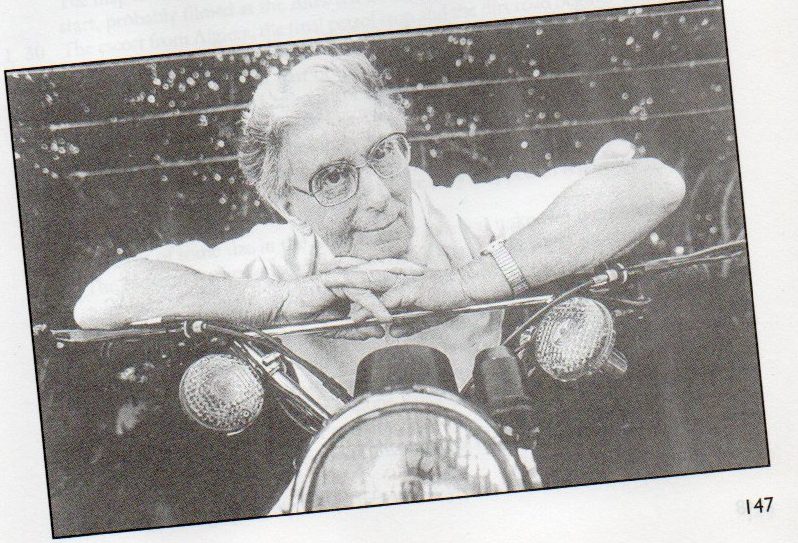
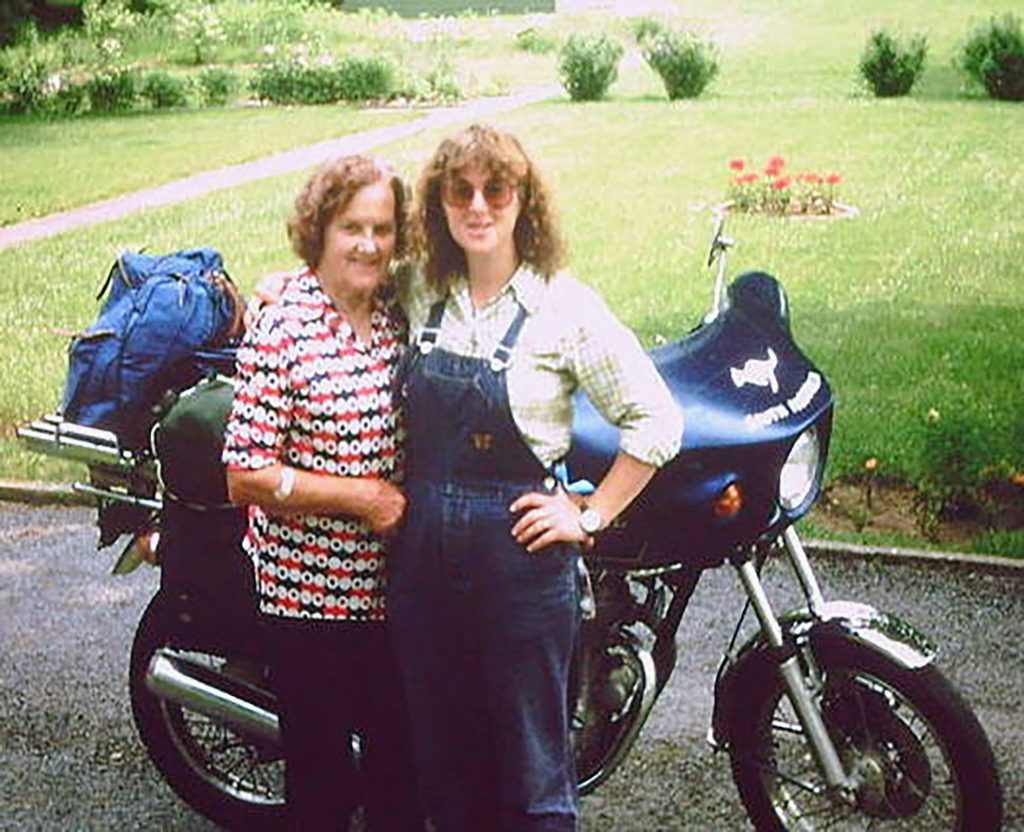
International President 1997-2003 and Ellen Pfeiffer Award recipient 2007
By the mid 1980s, Louise Scherbyn was becoming overwhelmed by the task of running WIMA. The overseas divisions organised themselves and there was little contact between countries except at annual Rallies. I felt this must change – all WIMA members could benefit from increased communication. Everything was done by post, though around the early eighties, computers were beginning to appear in offices.
In 1997, the divisional captains decided to elect a new president. They chose me to lead them, and I received a letter from Theresa Wallach, congratulating me and wishing me good luck. My bike throughout these years was my Suzuki Bandit GSF 600cc which I’d fallen in love with during the WIMA visit to Japan that Yuko Sugeta and myself organised in 1996.
The president and founder controlled everything in the original WIMA constitution – I wanted a more democratic organisation, so some of us wrote a simple document which included giving each country one vote, no matter their size. That principle still remains. Floh Petit, the de facto German captain, became international treasurer and we charged half a euro per member. The fund we built up enabled us to make yearly contributions to FEMA (Federation of European Motorcyclists Associations). Throughout my time, Floh was there, working behind the scenes, translating proceedings into German at every rally.
We held two captains’ meetings at each rally. The first, on the Tuesday to discuss issues and make recommendations. On the Wednesday, national captains presented these to their country’s rally participants, and on the Thursday the captains met again and we voted on the issues. A celebratory dinner followed, organised by the host country.
Rowena Inzani, a WIMA GB member, created a website for us, and registered www.wimaworld.com. Suddenly WIMA was available to anybody in the world with access to the internet! We heard from countries where we had no contacts and where we didn’t even know that there were women riding bikes. We were thrilled to hear from little-known Estonia and from Japan when motorcycle journalist Yuko Sugeta started attending our rallies from 1993.
I dreamed of a revival of WIMA USA, so Pat Thomson and I went to the AMA Women & Motorcycling Conference in West Virginia, at our own expense, and found Alice Sexton. (See WIMA USA divisional report, 2009 USA rally report and former international officers section).
We introduced sub-committees. Rita Koopmanschap and others worked on a comprehensive constitution. With increased participation from Australia, New Zealand, Japan and the USA, a new logo was needed. We invited logo designs from all divisions and the decision to choose the current oval logo was finally made during Rita’s time as international president. One last change I made, was to appoint the very efficient Doris Porter as vice-president as the WIMA workload had become too much. She started enthusiastically, but sadly died of cancer shortly afterwards.
WIMA has been an integral part of my life for over 40 years – I learned so much about other countries and WIMA communities during my six years as international president. WIMA has given me lifelong friends and my partner of 30 years Pat, without whose support I could never have managed this role. I shall always be grateful for the opportunity to make my contribution to this amazing organisation.
(2025)
Sheonagh was also a recipient of the Ellen Pfeiffer Award, along with Pat Thomson in 2007. Details can be found here…
The following introduction to Theresa appeared in the American Weekly on 30th October 1949
“The sun-browned woman on a motorcycle waved down the cowboy who was riding fast in the opposite direction. ‘I say there,’ she called out as he pulled his horse up short in a cloud of dust. ‘How far is it to the nearest town?’ He gazed at her in amazement. ‘Holy mackerel, Ma’am,’ he said. ‘Are you alone, way out here in this desert?’ She nodded laughing. ‘But I’m alright. I’ve been all over the world alone – Africa, Europe and most of your United States.’ ‘Are you crazy, or rich?’ he wanted to know. ‘Maybe I’m crazy, but I’m not rich. I’m almost stone broke, but I’ll pick up a bit of money some place, this is my transport.’ She patted her bike. ‘And I don’t need much else.’
What Theresa Wallach didn’t mention, was that for such travel you need courage and ingenuity and a lively spirit of adventure. She has done what most of us only dream of doing – she’s gone where and when she wanted to. A motorcycle champion, Miss Wallach has been travelling for years with all her worries left behind her and all her earthly possessions boiled down to what she can carry on her trusty motorcycle. First, she toured Europe. Then made the hazardous 10,000-mile (6,093 km) trip from Algiers to Cape Town, South Africa. In recent weeks she has travelled more than 25,000 miles (40,233 km) in the United States. Expenses are almost nil. She can go a long way on her motorcycle on a gallon of gas. She doesn’t have to worry about hotel reservations or paying hotel bills. When she’s tired, or sees an attractive spot, she pitches her tent for the night. Food is her greatest expense and when she runs low on money, she stops and gets herself a job. Sometimes she picks fruit or works on a farm or in a garage or gives lectures about her adventures on the road. She went to motor and aircraft maintenance schools in London and is a licensed mechanic both in England and in the United States. She can always pick up a job as a mechanic and with a few dollars she takes off again.”
In the Pearl Booklet, Frances relates:
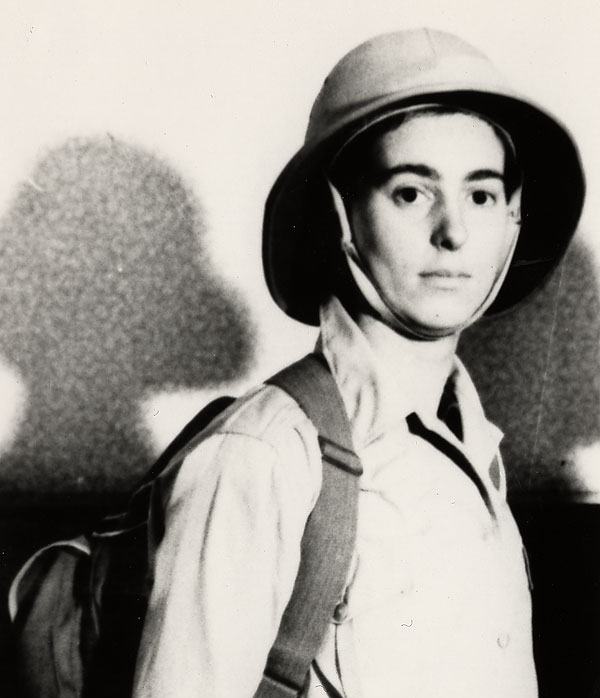
All sounds wonderful, doesn’t it? I feel that Theresa needs no introduction at all; in many ways she is responsible for my sitting down at the typewriter now. For ages, every time I opened a book or talked to anyone about women motorcyclists, the name Theresa Wallach kept coming to me. I shall list a few of her incredible achievements here: one of only three women to be awarded a Brooklands Gold Star (the Gold Star was awarded to any rider who managed to lap the Brooklands racetrack in England at over 100mph/160kph), made the first crossing on a motorcycle of the Sahara Desert, rode alone across America, started her own Norton importing business in America, wrote a book about learning to ride, started her own riding school, appeared on television, was one of the first women despatch riders in the Second World War and to cap it all from 1962 to 1977 she was International Vice-Captain of WIMA.
Theresa grew up in London. She used to watch the grown-up girls crowd out of the factories and rush off to queue for the cinemas and dance halls and Theresa used to shudder at the sight. ‘That’s not going to be the life for me,’ she said to herself. She also said it to her parents who thought she was a bit odd. To them the only way to live respectably was to stay at home, find a husband and settle down to a life of cooking and needlework. Theresa knew that she couldn’t do this. She told everyone that she was going to travel – to see Africa and the Sahara Desert, Hollywood, the Grand Canyon, New York and Paris.
She started doing something about this aim first by sneaking out on her brother’s pedal cycle and teaching herself to ride. Later she stood staring wide-eyed at motorcycles instead of at boys. She had to fight quite a bit at home to get her way. Soon her parents found out that she was actually riding. In 1926, when she was seventeen, they told her that unless she settled down, she would end up as nobody’s bride!
Between 1928 and 1932 Theresa studied engineering at the University of London and was an active member of a motorcycle club. She had competed in many types of sport, namely trials, scrambles and road racing. She felt she had the experience and confidence to look after a motorcycle in any circumstances. After another family argument about her life choices, Theresa went to her friend Florence Blenkiron’s house where she found her friend equally upset. Some of her family had moved to Capetown, South Africa and she missed them very much. ‘Cheer-up, said Theresa. ‘Suppose we use my bike and go and see them.’
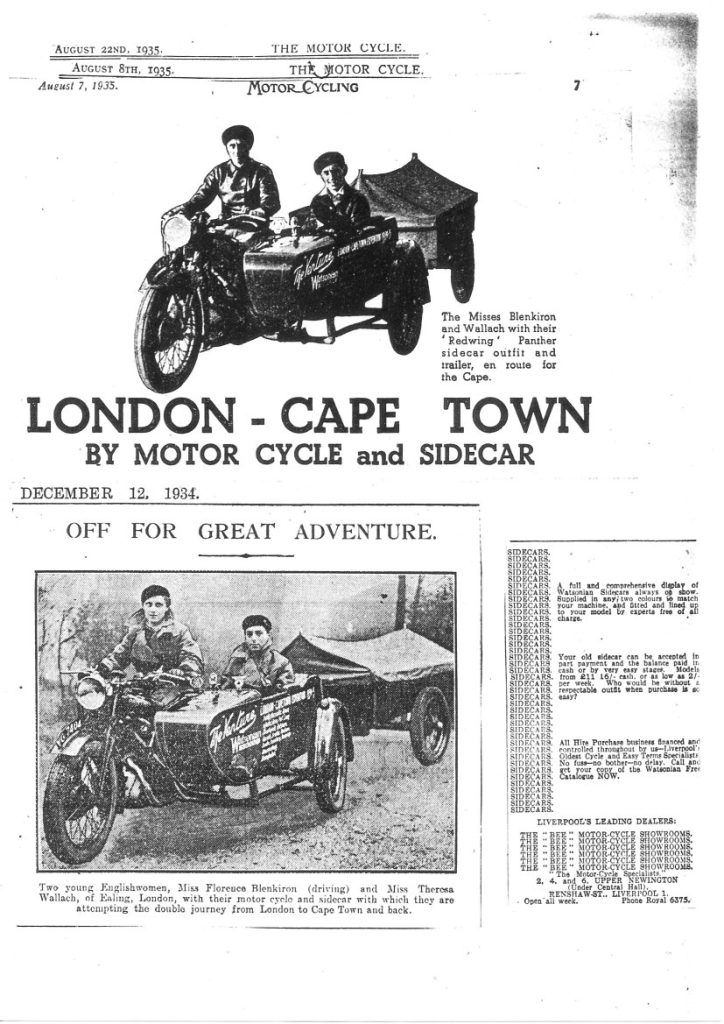
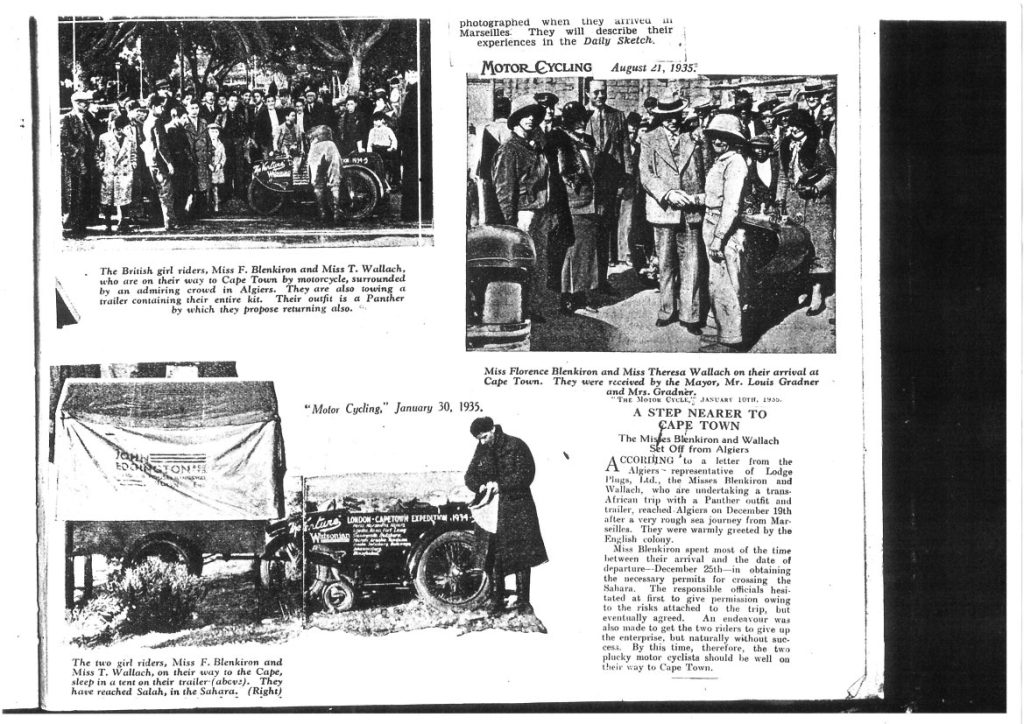
On 11 December 1934, Lady Astor, the first woman to take her seat in Parliament, gave an official send-off speech to the two daring women as they rode off from Africa House in the Aldwych with about a thousand Londoners watching them! From this day onwards, Theresa and Florence’s address was just as likely to be Post Restante, Desert Edge Petrol Pump, Algiers or Albuquerque.
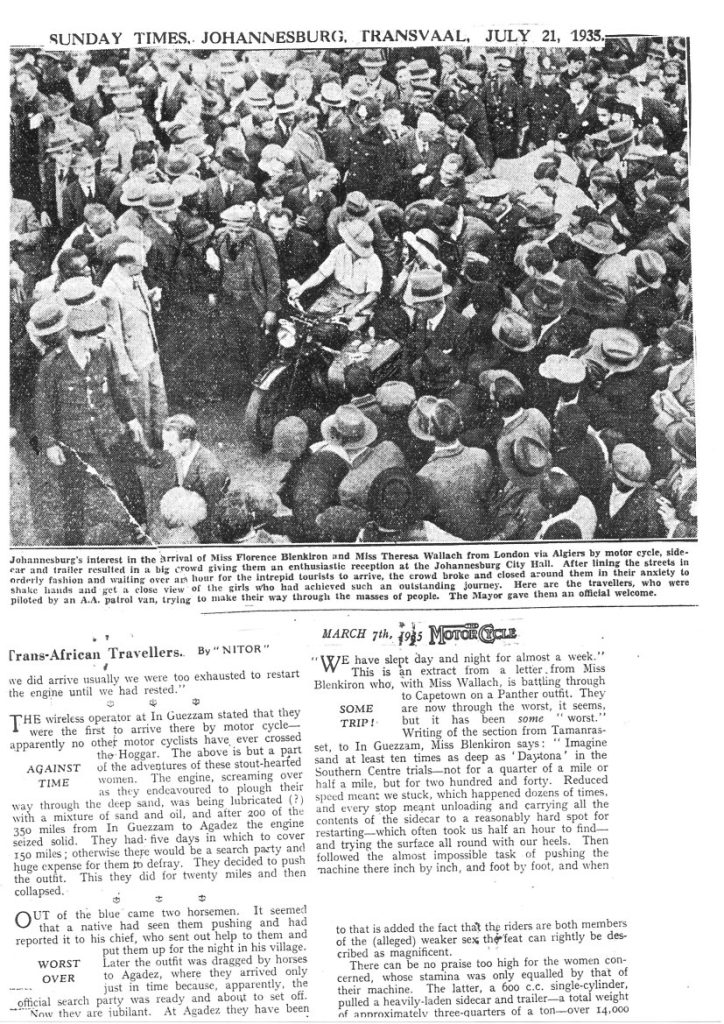
The bike was a 3 ½ horsepower Panther 600cc with a Watsonian sidecar and a six-foot trailer. They crossed Europe in a very cold December, took a boat across the Mediterranean, arrived in Algiers and set off to cross the Sahara. They were to meet with tribes who had never seen a motorcycle. As a discouragement to lions, they carried a powerful flashlamp and two business-like revolvers. For almost a year, they endured some difficult experiences, such as “running a big-end” in the desert, running out of petrol in the jungle, and eating bread so hard they had to chip the loaf with a hammer and screwdriver! They soon forgot the unpleasantness of these times at the sights and splendours of Africa and Table Mountain, which was their goal. It’s not known what happened to the bike; Theresa returned home by ship while Florence obtained another Panther with the intention of riding back to London. She made it as far as Nigeria but was forced to trailer it across the Sahara to Algiers and riding it home from Europe.
Their arriwal in Joburg as reported in The Sunday TImes
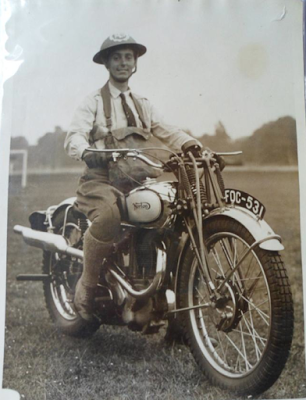
Although both girls missed their home and family, nothing could deter Theresa from wanting to see more of the world. Unfortunately, her ambitious intentions, as well as those of many others, took a setback at the outbreak of World War II. Despite the war, Theresa didn’t stop riding. She joined the Transport Corps as soon as the Women’s Auxiliary Territorial service (ATS) was mobilised. Thousands of miles of convoy work in air raids and blackouts meant special means of transport. Orders were released to issue Theresa with a motorcycle, and she thus became one of the first women despatch riders. For the first time, women motorcycle troops were able to compete against other army regiments in motorcycle competitions. Theresa spent seven years in active service during the war.
Theresa as a dispatch rider
Towards the end of the war, the Transport Corps was absorbed into base workshops. Two years before she was released from the army, Theresa was transferred to a unit of the Royal Electrical and Mechanical Engineers, where she was the first woman to pass the mechanics fitters exam. She was very disappointed that women did not rally to the workshops quicker.
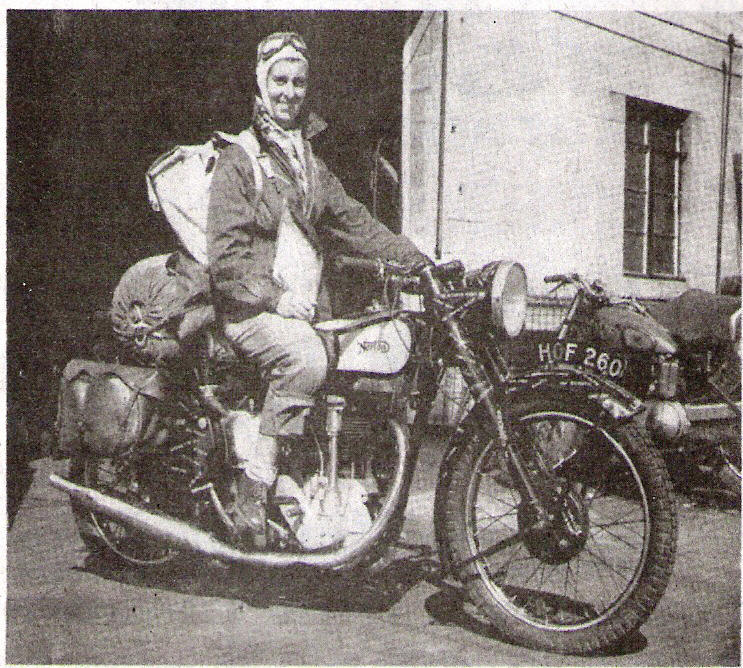
For Theresa, the return to ‘Civvy Street’ simply meant transfer to a white ration book and to controlled labour. In under a year, she was on the move again. She wanted to see America. Landing in New York with a new motorcycle, she wasn’t too bothered with reservations, finances, luggage or any of the other things most travellers concern themselves with. Equipped with sleeping bag and a pair of saddlebags, fuller of spanners and maps than clothes, she managed some interesting tours. Theresa stayed in America for two and a half years; in that time, she covered 32,000 miles(51,500 km) and at one time or another had 18 jobs!
At the end of her tours, Theresa’s bike was put on display on the Norton stand at a motorcycle show in New York and it was there in 1952 that Louise Scherbyn met her and introduced her to WIMA. After this, Theresa returned to England, rode her ‘cammy’ Norton to the factory in Birmingham and was presented with a new machine by the company.
Theresa on her Norton
Theresa, however, did not stay in England long. In less than a year, she returned to America, this time to start up a motorcycle business. After the war years, export was vital to British industry and their bikes were in great demand in the States, but few people knew very much about them. Theresa dealt especially in British bikes, mainly Norton and Triumph. At this time, she was the only woman to own and run her own motorcycle business. Her shop not only sold, serviced and repaired bikes, but Theresa also decided to start giving riding lessons as well. The business thrived for many years, but finally started to decline in the 1970’s, with the influx of Japanese machines on to the American market.
In 1973, Theresa packed up the shop in Chicago and moved to Phoenix, Arizona where she started her own motorcycle riding school. Teaching riding was not a new venture for Theresa; she was already something of an expert. In 1970 she published a book ‘Easy Motorcycle Riding’ and in the following year she made several television appearances in which she talked about the need for young riders to take a course of proper instruction on two wheels. The book is a very comprehensive introduction to riding and is especially to be praised as most of the illustrations in it show women riders, which is rather unusual. Her book has been a great success and is now reprinted for the fourth time. When Theresa’s Riding Academy opened, nothing like it had been seen before in the States. Students come from all over the country. The students’ riding record is Theresa’s gratification; many of them write to tell of their five-figure mileage records, and still no problems. They are the ones who prove her work.
Frances concludes her piece on Theresa:
I want to repeat the very well-known story of how she achieved her Brooklands Gold Star in 1939. In his biography, Francis Beart, the ace Norton tuner, recalls how one day Theresa walked into his workshop at Brooklands and asked if she could borrow his 348cc International Norton for the next weekend’s British Motorcycle Racing Club (BEMSEE) meeting. Francis Beart told her it would cost a fiver! She hadn’t one, but returned later, having borrowed the money. When the day came, it was pouring with rain, but her lap was timed at 101.64mph! Theresa’s was one of the last Gold Stars to be awarded before Brooklands was closed down by the War. Around this time, Theresa was a regular attender at Brooklands along with her friends in the London Ladies Motorcycle Club in which she was a keen and active member.
Today (Frances wrote in 1980), Theresa is fully occupied with her riding school and had to drop the position of WIMA’s International Vice President, held until 1977, a post which Louise has yet to fill. However, Theresa has by no means hung up her helmet. She still makes occasional tours on her Honda 500/4 or uses one of her 100cc Kawasaki ‘trainer’ bikes for local trips. She lives in beautiful Arizona, on the doorstep of the Grand Canyon. She tells me the only way to penetrate the ramparts of the Grand Canyon is by mule! So, one fine day, Theresa hired such a beast, called ‘Daisie’ and rode the vertical mile down a three-foot ledge to the Colorado river! At the moment, (when not working in her riding school), Theresa is writing a book about her many adventures. Hurry up Theresa we can’t wait.
Current Members’ recollection
One GB member who travelled to the US, Sheila Whittingham, has added her memories of Theresa. “In 1995, I wrote to her before our trip and received a very friendly letter. She gave us directions and we spent a nice afternoon with her. She was very welcoming and gave us tea and biscuits – I remember a packet of real English ginger biscuits complete with a union jack emblem on the packet. She showed us her Gold Star and other photos and gave me two lovely gifts to take home, a signed copy of her book (Easy Motorcycle Riding) and a picture of a Navaho kachina doll, both of which I still have.” Sadly, she didn’t want her photograph taken and was more interested in finding out about Sheila’s life and travels than talking about herself!
Sheonagh Ravensdale’s postscript to the 1980 history: Theresa remained an active member of WIMA GB throughout her time in the USA, eagerly reading the monthly GB newsletter in Phoenix, until her death on her 90th birthday in 1999. As Captain of WIMA GB from 1993 to 1999, Sheonagh recalls getting regular letters from Theresa commenting on the newsletter, often complaining about the language in it! Theresa never managed to get the incredible tale of the Africa trip published during her lifetime. That task was taken up by editor Barry Jones of Panther Publishing after she died and ‘The Rugged Road’ was published in 2001 to immediate acclaim. A second edition with updated information was published in 2011. Theresa had made a 16mm cine film of the journey and gave many presentations using this footage during her travels in the USA. A video made from the film footage was launched in the UK around the time of the first edition of the book. You can see it here: https://www.brooklandsmuseum.com/explore/stories/brooklands-stories/from-brooklands-to-phoenix-arizona-via-capetown.
In 2003, four years after her death, Theresa was inducted into the AMA Motorcycle Hall of Fame. Because of ‘The Rugged Road’, Theresa is possibly better-known internationally than Louise, but both women have been an inspiration to us all ever since we first discovered them early in our riding careers. When travelling in remote places, with problems on the road, Sheonagh has found herself muttering “Now what would Theresa do?”
Frances Popley wrote in 1980: Louise, as almost all members must by now know, is the Founder of The Women’s International Motorcycle Association. Without her, this book would never have been written and many of the events in it would never have taken place. Unfortunately, I have never met this remarkable and inexhaustible lady, but I do have a detailed account, written by her, of how the Association began.
Louise’s interest in motorcycling started in the early 1920s when she sat on a 1921 Indian, which was owned by a lad who came to visit her elder sister. A few years later, her brother bought an old Indian. In 1924 Louise had her first ride in a sidecar; at first, she was scared, but then found it great fun.
Years passed, Louise grew up and got married. Her husband started yearning for two wheels again as he had owned several machines before they met. So Louise became a pillion rider on a Harley Davidson. This was soon replaced by an Indian Chief and Louise once again had the pleasure of riding in a sidecar. In 1932 Louise’s husband decided that because she was so keen on bikes, he would get her one of her own. The idea frightened Louise, as women drivers were almost unheard of and she was a little worried about the effect riding would have on her reputation, as she was supposed to be ‘ladylike’ and ‘dignified’. She held a good position in the Kodak company and wondered what the rest of the office would think of her ‘putting about’ in the city on a motorcycle!
Louise need not have worried; it was soon known that she had taken to two wheels and every Monday morning her colleagues would ask “Where did you go this weekend?” She kept her good reputation and she and her husband joined the Kodak City Motorcycle Club and later the Wayne County Club. Soon Louise was active in many motoring clubs including the American Motorcycle Association, the Canadian Motorcycle Association and the British Pathfinders Club.
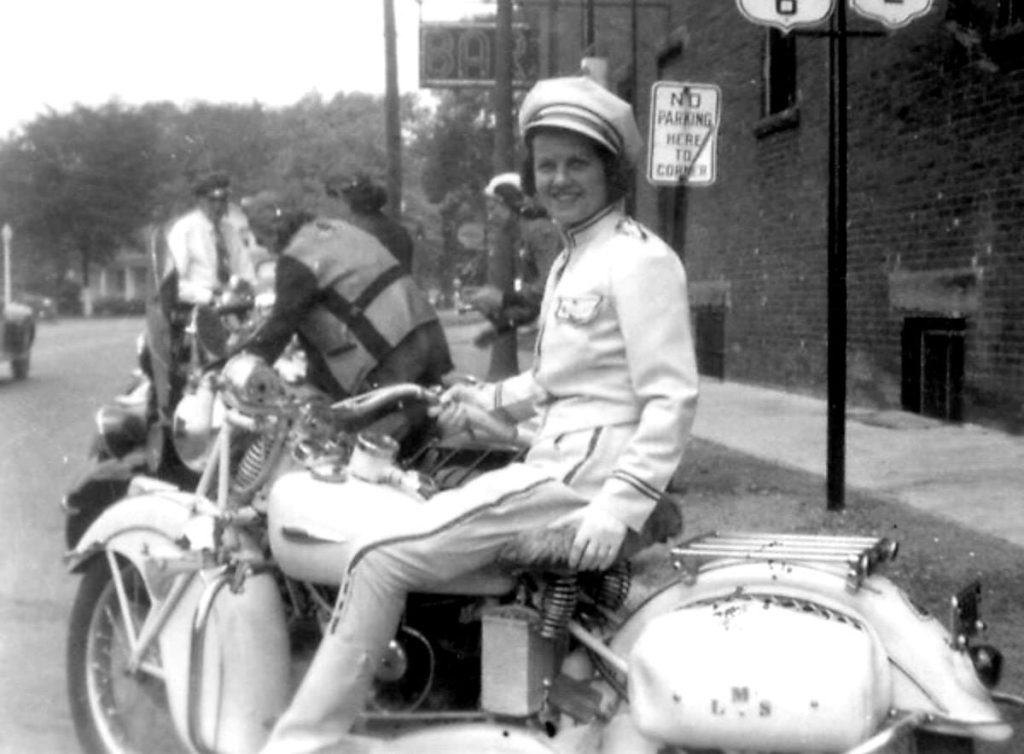
It was then that she became interested in women motorcyclists in particular. She joined, and helped to revive the Motor Maids, set up in the 1940s with various branches throughout America. It was not so much a motorcycle club, more of a display team. The girls in it used to do a formation ride around the track at the start of a race meeting. They wore smart blue uniforms, and their bikes were always beautifully turned out. Louise so much enjoyed the experience of getting The Maids together again that, when she moved back to Waterloo, she enlisted the assistance of another girl and formed the Waterloo Twilight Roamers Motorcycle Club. During the WIMA twentieth Anniversary celebrations, Louise was presented with an Honorary Life Membership of this club.
Louise’s interest in motorcycle publications began with her riding, first with her attempts as a reporter of club news, then as a contributor of articles which appeared in several publications. She became the Associate Editor of one of America’s leading motorcycle publications and for the past fifteen years Louise has, of course, been the Editor of the International edition of the WIMA Newsletter which members receive each quarter.
Let’s get back to Louise’s riding. Louise’s first machine was a 1932 Indian Scout. Her training ground was a gravel road; three lessons later, she was riding through city traffic. Since then, she has been riding continuously on various models of Indian. In her many miles she has never had an accident! Her trips have taken her to many parts of the USA and Canada. She undertook her first long journey (1,200 miles/1,931 km) to Chicago in 1937. Louise believes that she can lay claim to the distinction of being the first American woman to reach the far North – the Temagami Forest of Canada. This was in fact rather more of a feat than it sounds. The trip was in 1937, when many main roads in Canada were still made of dirt and gravel and were very rutted and rough. Louise also feels that she may have been the first American woman to compete in a foreign competition. In 1948 she rode in a 720-mile/1,159 km enduro in Canada. During this period Louise took part in many events, but her main love was touring.
Louise demonstrating her riding skills at the first All Girls Motorcycle Show in the USA
During the 1940s, the number of women riders increased, and Louise believed that there should be more activities for them. Her belief in this grew stronger and stronger and she started thinking about a world-wide organisation of all women motorcyclists. It was during the second World War while Louise was exchanging correspondence with many women in various parts of the world, that she became obsessed with this new idea. Why not unite as a body, exchanging ideas, problems and advice? It would add considerably towards improving the atmosphere, the good companionship, and marvellous fun of competition and touring and all that is characteristic of the sport. She felt sure that others would agree with her. At this time, women abroad were competing in a wider range of events than in America and were doing well. Why? Mainly, Louise felt, light-weight motorcycles had proved their safety and easy handling among women riders. With the influx of these machines from abroad – here was an encouraging outlook. Why couldn’t American women look forward to uniting and increasing their opportunities in competitions as riders? Why couldn’t women unite their interests into one big Association? With this thought, came the initial step of founding The Women’s International Motorcycle Association.
Someone said to Louise at the time that this endeavour would be impossible! But Louise’s love of the sport and her determination kept her going and she made it a possibility and then a successful reality. Once she had completed the groundwork, she enlisted the help of two of her friends, Mrs. Hope Jones and Miss Grace Conrad. So I suppose they could be called the first two WIMA members! I’ll let Louise have the last words: “With the help of every member and some wonderful friends, the WIMA has now grown today to be the largest women’s motorcycle organisation in the world.”
Here, with only limited space available and only ordinary words at my disposal I cannot think of a suitable tribute to pay to a woman, who was not only our founder but who has also devoted a lifetime to the Association. Louise, a Big Thank You from all of us.
Current Members’ recollections
Former GB member, founder of the WIMA Australia division, Linda Bootherstone-Bick stayed with Louise in summer 1983, and helped her get the international newsletter out. Louise sorted out a 360 Honda upon which Linda set off on a 13,000-mile journey staying with WIMA USA members all over the country.
Louise and Linda Bootherstone-Bick, 1983
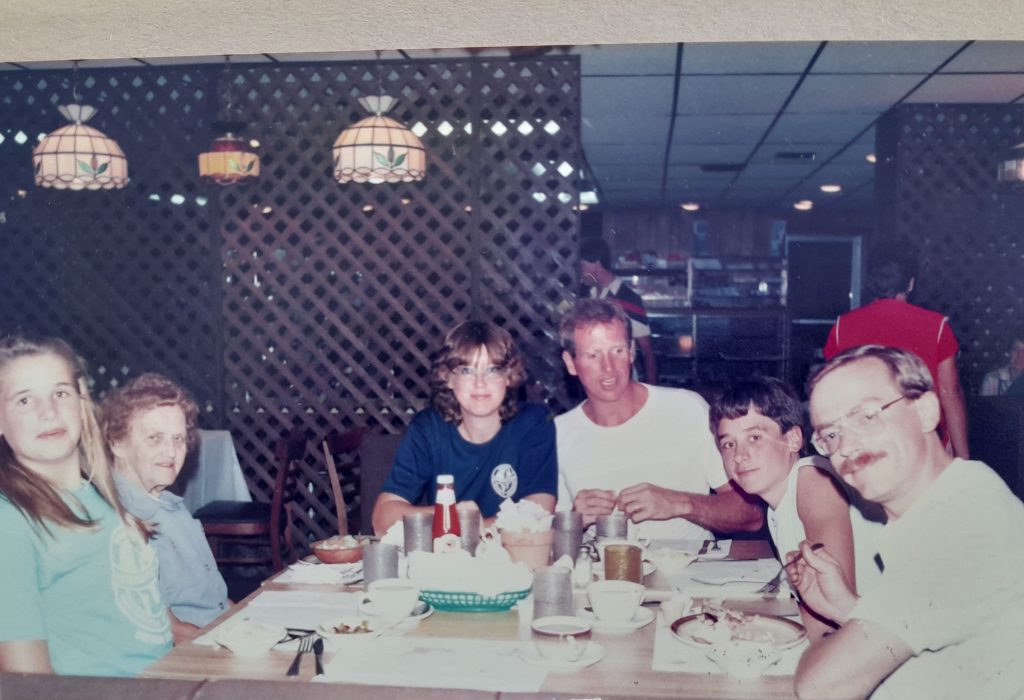
GB members Widge Thorpe and Rose Wilbraham, plus Widge’s husband and daughter visited Louise at her home in Waterloo, NY in August 1986. Louise made them very welcome, and they stayed overnight camping close by. Widge recalls: ‘We had proudly worn our ‘British Division’ WIMA tee shirts, but Louise was indignant that anything other than official USA regalia in red, white and blue existed. Oops. She had strong views about a number of motorcycling issues – we decided it was diplomatic to just nod in agreement.
‘We took Louise to a local diner for an evening meal before settling down for the night in the tents. The etiquette of American buffet eating was new to us. Louise happily tucked into plain fish with red jello to follow. Next day, before we left, Louise showed Rose and I a tea-chest half full of correspondence from all over the world that she needed to deal with. Her stay in hospital had caused a backlog. It was an interesting experience that I am grateful for. The culture of Louise’s WIMA in the USA at that time was very different from ours in WIMA GB. The focus seemed to be on leading parades and wearing identifying regalia rather than riding the scenic roads of the country and meeting up at rallies as in the UK.’
Louise’s and Widge’s family dine toogether in Waterloo, 1986
Louise’s health was declining by the time of Widge’s family visit in 1986 and she spent the final part of her life in a retirement home in New York. Her 1940 Indian motorcycle and her collection of over 350 toy motorbikes are in the INDIAN motorcycle museum, Springfield, Massachusetts.
Louise’s bike in the Wood Museum of Springfield History in Massachusetts
A book called Iron Horse Cowgirls: Louise Scherbyn and the Women Motorcyclists of the 1930s and 1940s was published in the USA by McFarland in 2023. Written by Linda Back McKay and (WIMA USA member) Kate St. Vincent Vogl (www.katevogl.com).